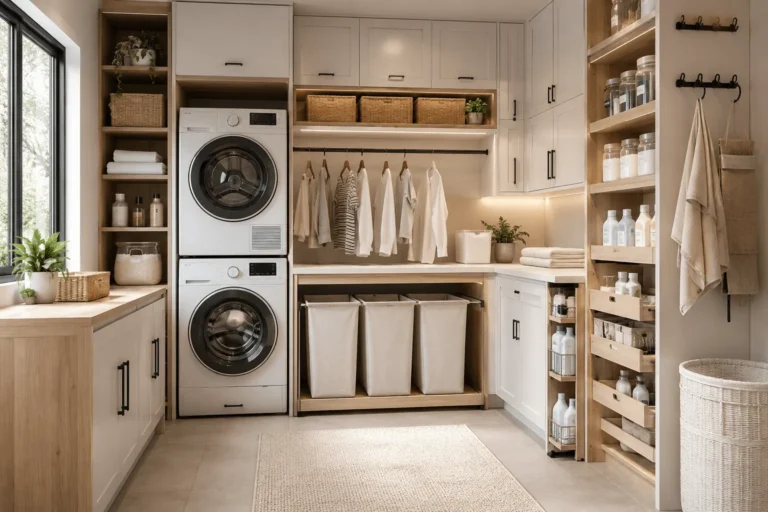
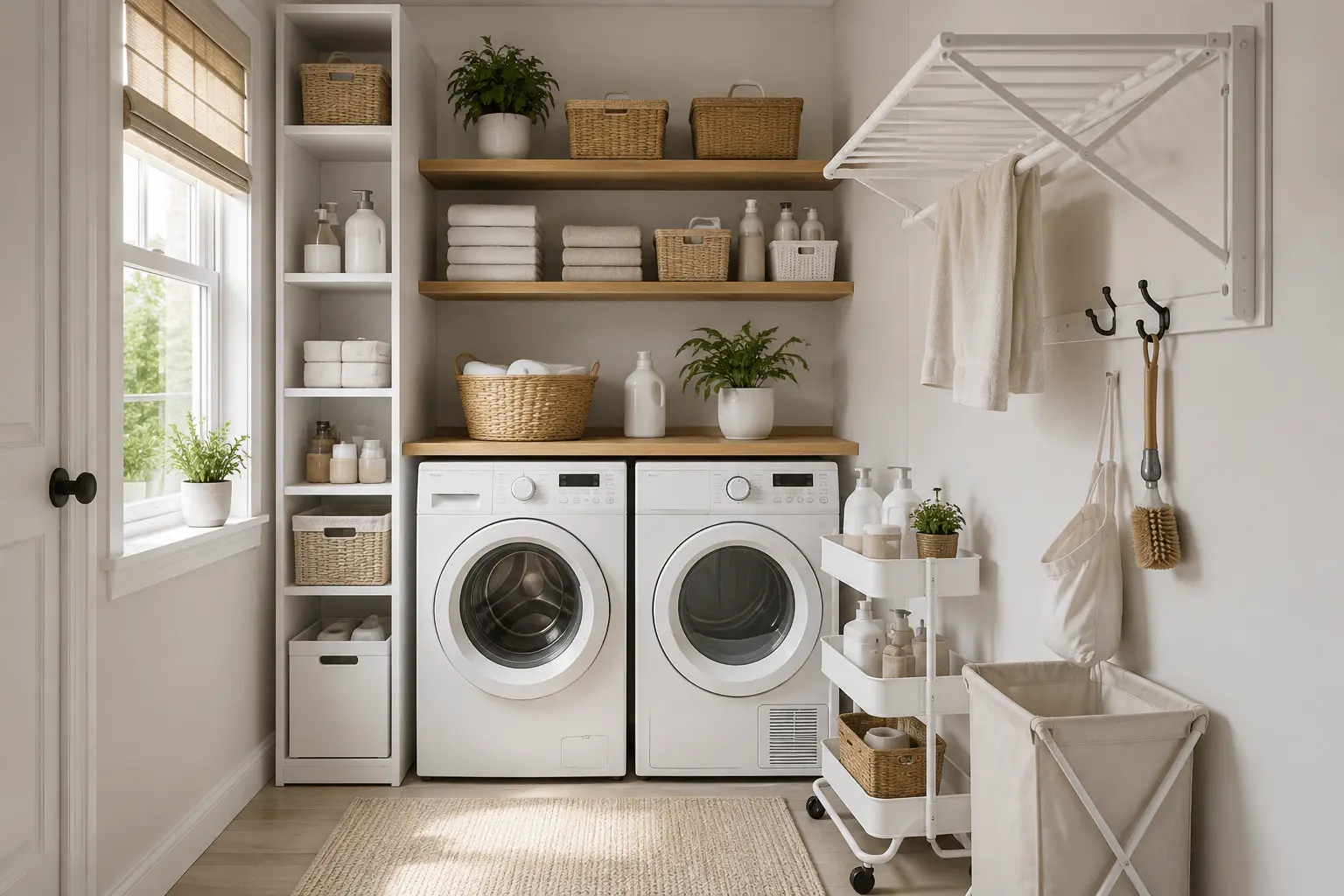
Introduction
Small laundry rooms can become cluttered quickly because they often need to accommodate a washer, dryer, laundry baskets, detergents, cleaning supplies, drying equipment, and sometimes a folding area—all within a limited footprint. The good news is that a lack of floor space doesn’t mean you have to sacrifice organization or functionality.
With the right layout and storage strategy, even a narrow laundry room, laundry closet, apartment utility area, or compact laundry nook can become efficient and easy to maintain. The key is to use vertical space, choose appropriately sized organizers, eliminate unnecessary clutter, and give every item a designated home.
This guide shares practical laundry room organization ideas for small spaces, including space-saving shelving, slim storage carts, wall-mounted drying racks, compact folding stations, renter-friendly solutions, and affordable organization hacks.
Quick Answer
Laundry room organization ideas for small spaces focus on maximizing vertical and unused areas while keeping the floor clear. Use floating shelves, slim rolling carts, stackable bins, wall-mounted drying racks, over-the-door organizers, fold-down tables, and narrow hampers to create practical storage without making the room feel crowded. Decluttering first and assigning dedicated zones for washing, drying, folding, and supplies can make even a tiny laundry room more efficient.
Table of Contents
Affiliate Disclosure
Some links on this website are affiliate links. If you make a purchase through these links, we may earn a small commission at no additional cost to you. This helps support our work and allows us to continue creating helpful content.
Why Small Laundry Rooms Need a Different Organization Strategy
Small laundry rooms require a more intentional approach to organization because every inch has a purpose. In a large utility room, you may have enough space for freestanding cabinets, wide hampers, a folding island, and multiple storage shelves. In a compact laundry area, those same solutions can quickly make the room feel crowded.
The best small laundry room organization strategy focuses on vertical storage, multifunctional products, clear walkways, and easy access to everyday essentials. Instead of trying to fit more furniture into the room, think about how unused walls, doors, appliance gaps, and overhead areas can provide additional storage.
The Biggest Challenges in Small Laundry Rooms
One of the biggest challenges is simply having too many functions in a limited area. The laundry room may need to handle washing, drying, sorting, folding, stain treatment, cleaning, and storage at the same time.
Common challenges include:
- Limited floor space
- Narrow walkways
- Few or no built-in cabinets
- Insufficient folding surfaces
- Too many cleaning products
- Bulky laundry baskets
- Limited drying space
- Poor use of wall space
- Difficulty storing backup supplies
- Clutter around the washer and dryer
Identifying these problems first makes it easier to choose storage solutions that actually solve your space limitations.
The Goal: More Function Without More Clutter
The goal isn’t to fill every empty area with storage. Instead, the objective is to create more useful storage without making the room harder to move around in.
For example, a slim rolling cart may provide more practical storage than a large cabinet because it can fit into an unused gap. Likewise, a wall-mounted drying rack can provide drying space without taking up valuable floor area.
A successful small laundry room should feel open, organized, and easy to use—not packed with organizers.
Declutter Before Adding Storage
Before purchasing shelves, baskets, cabinets, or organizers, remove items you no longer need. Storage products cannot solve a clutter problem if the room contains unnecessary supplies, duplicate products, broken tools, or items that belong elsewhere.
Decluttering first also helps you determine how much storage you actually need. You may discover that you need fewer organizers than expected.
Remove Items You Rarely Use
Start by reviewing everything currently stored in the laundry room. Separate everyday necessities from items that are rarely or never used.
Consider removing:
- Empty containers
- Broken laundry accessories
- Old cleaning tools
- Products you no longer use
- Duplicate supplies
- Clothes that need to be relocated
- Unrelated household items
Keep frequently used laundry essentials accessible and move seasonal or occasional items to higher storage or another appropriate location.
Consolidate Duplicate Supplies
Small laundry rooms can quickly become overcrowded when multiple partially used containers contain similar products.
Check your shelves and cabinets for duplicate supplies. Where appropriate, consolidate compatible products into clearly labeled containers, while following the product manufacturer’s storage and safety instructions.
Avoid keeping excessive quantities of products simply because they were purchased in bulk. Backup supplies should have a designated storage location rather than occupying your primary work area.
Create a Small Laundry Essentials Zone
Once unnecessary items have been removed, create a dedicated zone for the products you use most often.
Your everyday zone might contain:
- Laundry detergent
- Stain remover
- Laundry bags
- Dryer supplies
- Measuring tools
- Cleaning cloths
Keeping daily essentials together reduces searching and prevents frequently used products from spreading across shelves and countertops.
Pro Tip
Don’t buy storage before decluttering. Removing unused products first helps you determine how much storage you actually need.
Make the Most of Vertical Wall Space
When floor space is limited, look upward. Walls are often the most underused storage opportunity in a small laundry room.
Vertical organization allows you to store more without narrowing the walking area. Shelves, cabinets, hooks, rails, pegboards, and wall-mounted accessories can turn an empty wall into a highly functional storage zone.
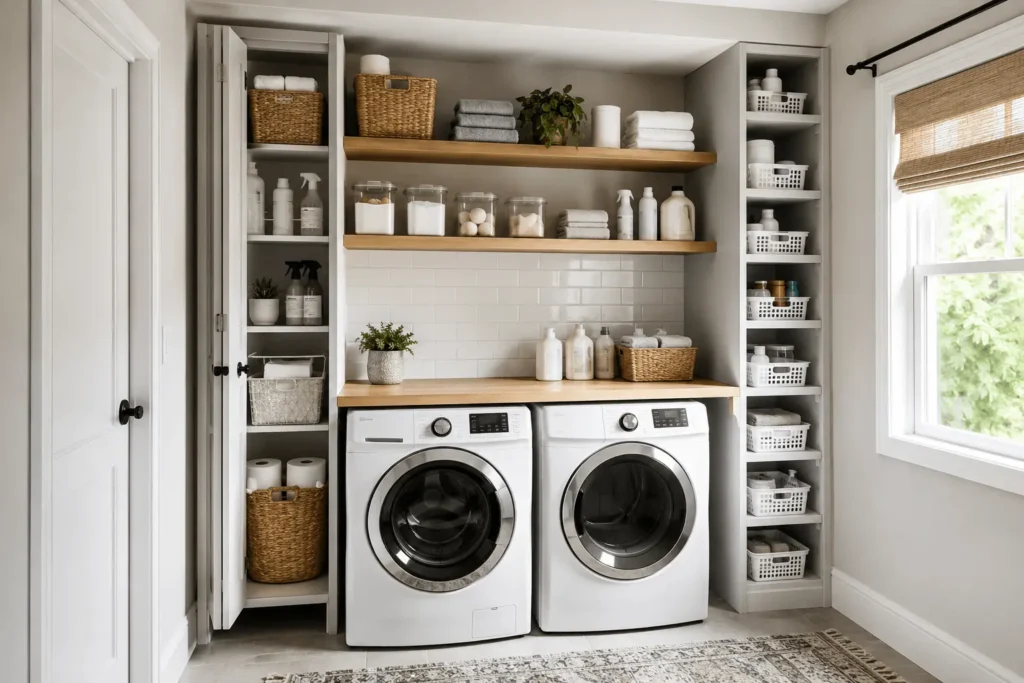
Install Floating Shelves
Floating shelves are one of the simplest ways to add storage without installing bulky floor furniture.
Use them for lightweight or frequently accessed items such as:
- Laundry baskets
- Folded towels
- Detergent
- Cleaning cloths
- Small storage containers
- Decorative baskets
For a small laundry room, avoid filling every shelf with loosely arranged products. Matching baskets or labeled containers can make open shelving look cleaner and more intentional.
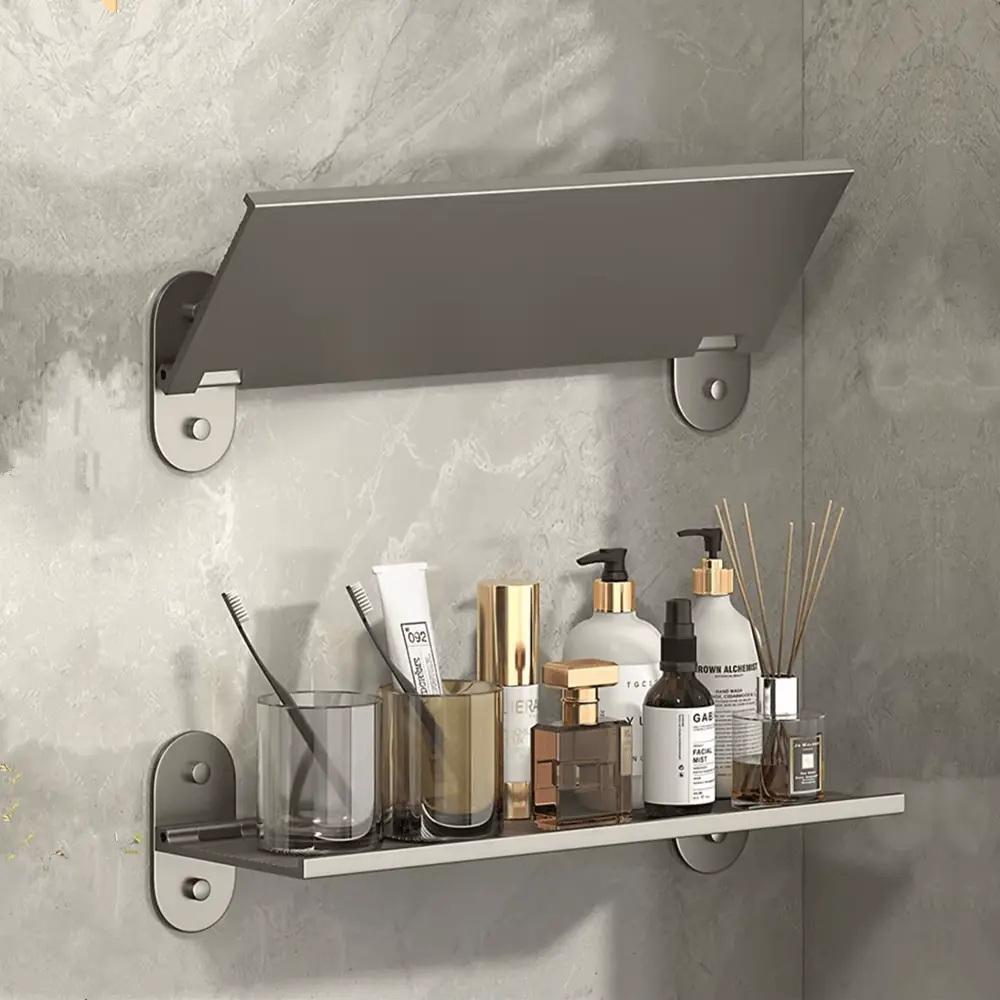
Wall-Mounted Foldable Storage Rack
Save valuable floor space with this wall-mounted foldable storage rack, designed for compact laundry rooms and other small spaces. Its aluminum frame, single-tier design, and foldable function provide a practical spot for lightweight laundry or household essentials without taking up floor space.
Best For:
● Small laundry rooms
● Wall-mounted storage
● Laundry essentials
● Compact utility spaces
● Space-saving organization
Key Features:
● Foldable design — Helps save space when not in use.
● Wall-mounted installation — Keeps storage off the floor.
● Aluminum frame — Lightweight and practical.
● Single-tier rack — Simple storage for everyday essentials.
● Multiple uses — Suitable for laundry, bathroom, and utility areas.
● Stain resistant — Easier to maintain and keep clean.
● No assembly required — Ready for installation.
● Space-saving solution — Ideal for compact rooms.
Use Adjustable Wall Shelving
Adjustable shelving is useful when your storage requirements may change over time. Shelves can be repositioned to accommodate taller detergent bottles, baskets, cleaning tools, or other household supplies.
This flexibility is especially useful in growing households where storage needs change.
Add a Narrow Wall-Mounted Cabinet
If you prefer to keep laundry supplies hidden, consider a shallow wall-mounted cabinet.
A narrow cabinet can provide concealed storage while keeping countertops and shelves visually clean. Choose a depth that allows doors to open comfortably without interfering with appliances or walkways.
Use the Space Above the Washer and Dryer
The wall above the washer and dryer is often prime storage real estate.
Depending on your appliance configuration and installation requirements, this area can accommodate:
- Shelves
- Cabinets
- Baskets
- Drying accessories
- Laundry supply containers
Always ensure that any wall-mounted storage is installed securely and does not interfere with appliance ventilation, servicing, doors, controls, or manufacturer requirements.
Expert Tips
In a small laundry room, look upward before adding more furniture. Wall shelves and cabinets can increase storage without reducing valuable floor space.
Use the Space Between and Beside Appliances
Small gaps beside or between appliances can become surprisingly useful storage areas. Instead of allowing these narrow spaces to collect dust, measure them carefully and consider purpose-built storage.
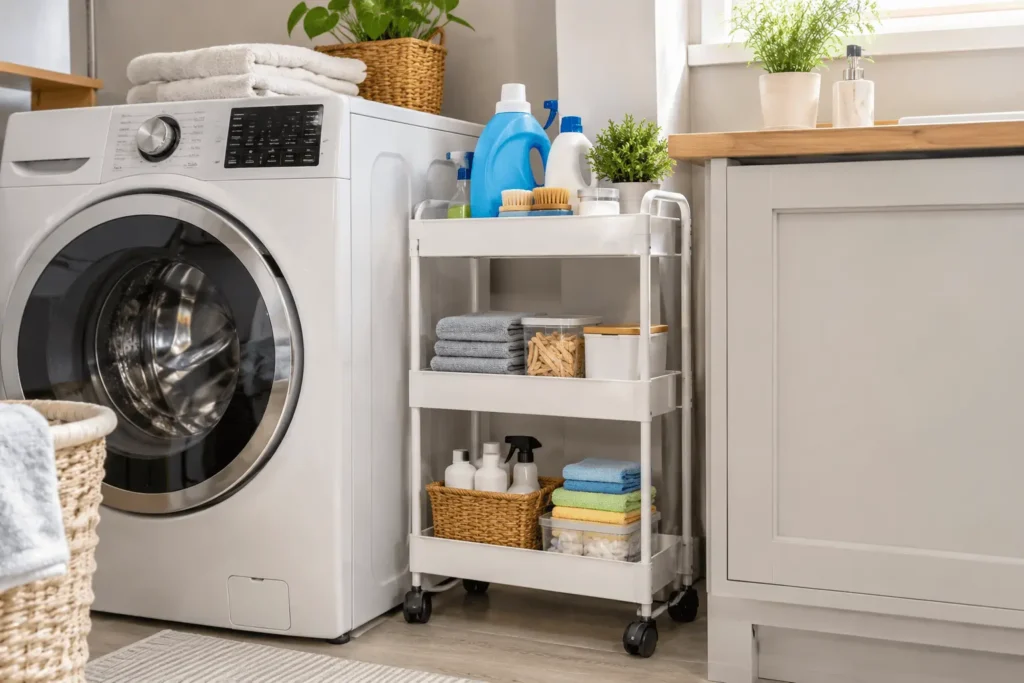
Add a Slim Rolling Laundry Cart
A narrow rolling cart can fit into spaces that are too small for conventional cabinets.
Use different levels for:
- Detergent
- Stain removers
- Cleaning cloths
- Laundry tools
- Backup supplies
The biggest advantage is flexibility. You can pull the cart out when needed and return it to its storage position afterward.
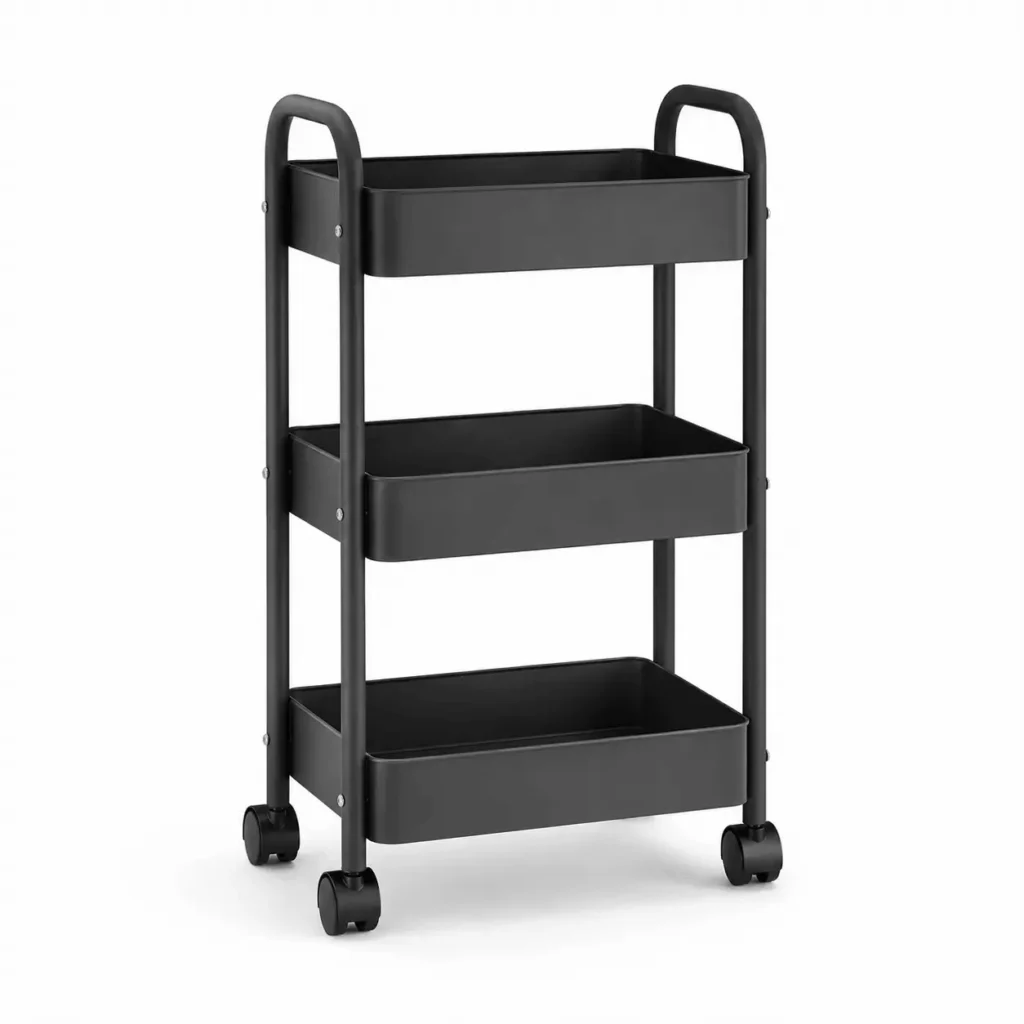
3-Tier Slim Rolling Storage Cart
Maximize unused spaces with this 3-tier slim rolling storage cart. Its 27 cm depth fits neatly beside laundry appliances, cabinets or narrow gaps, while three metal baskets provide convenient storage for detergents, cleaning supplies and everyday laundry essentials.
Best For:
● Small laundry rooms
● Narrow storage gaps
● Laundry supplies and cleaning products
● Apartments and dorm rooms
● Flexible, movable storage
● Maximizing vertical space
Key Features:
● 3-tier basket design for organized storage
● Slim 27 cm depth fits narrow laundry spaces
● Smooth-rolling wheels for easy mobility
● Durable carbon steel + PVC construction
● Raised basket edges help prevent items from falling
● 2 hanging hooks for small laundry accessories
● Compact 66 cm height maximizes vertical storage
● Ideal for detergents, cleaning supplies and laundry essentials
Install a Narrow Storage Tower
A vertical storage tower can make use of height rather than width. This is particularly useful in narrow laundry rooms where floor space is limited.
Choose a tower that leaves sufficient clearance for appliance doors and comfortable movement.
Keep Frequently Used Items Within Reach
Not everything should be stored in the highest available location.
Place daily-use products where they can be reached easily. Reserve upper shelves and less convenient storage areas for items used less frequently.
This creates a practical hierarchy:
Daily essentials → Easy-to-reach storage
Occasional supplies → Secondary storage
Rarely used items → Higher or hidden storage
Pro Tip
Measure every available gap, including the space beside appliances and behind doors, before purchasing a storage product.
Choose Storage That Does More Than One Job
Multifunctional products are especially valuable in small laundry rooms because one item can solve several organizational problems.
Instead of buying separate furniture for every task, look for solutions that combine storage, workspace, mobility, or sorting.
Use a Folding Countertop for Storage and Folding
A countertop above front-loading machines can create a useful folding surface while visually connecting the appliances.
The space beneath or around the countertop can potentially accommodate baskets or other suitable storage solutions.
The result is a dedicated work surface without requiring a separate folding table.
Choose Storage Benches With Hidden Compartments
If your laundry area includes enough space for a small bench, a storage bench can provide two functions: seating and concealed storage.
It may be useful for storing:
- Laundry bags
- Extra towels
- Seasonal supplies
- Household textiles
Avoid adding a bench if it significantly restricts movement in an already narrow room.
Use Baskets That Can Move From Shelf to Shelf
Lightweight baskets are useful because they can function as both storage containers and portable laundry organizers.
For example, one basket can hold cleaning cloths while another stores laundry accessories. When you need the contents, you can simply remove the basket instead of searching through individual containers.
Choose Stackable Containers
Stackable containers make better use of vertical cabinet and shelf space.
They work particularly well for:
- Small accessories
- Laundry bags
- Cleaning cloths
- Spare supplies
- Seasonal items
Choose stable containers designed to stack safely rather than creating unstable towers.
Create a Small Laundry Folding Station
You don’t need a large laundry room to create a useful folding station. A compact folding area can make a significant difference in workflow by giving clean clothes a designated place to be folded.
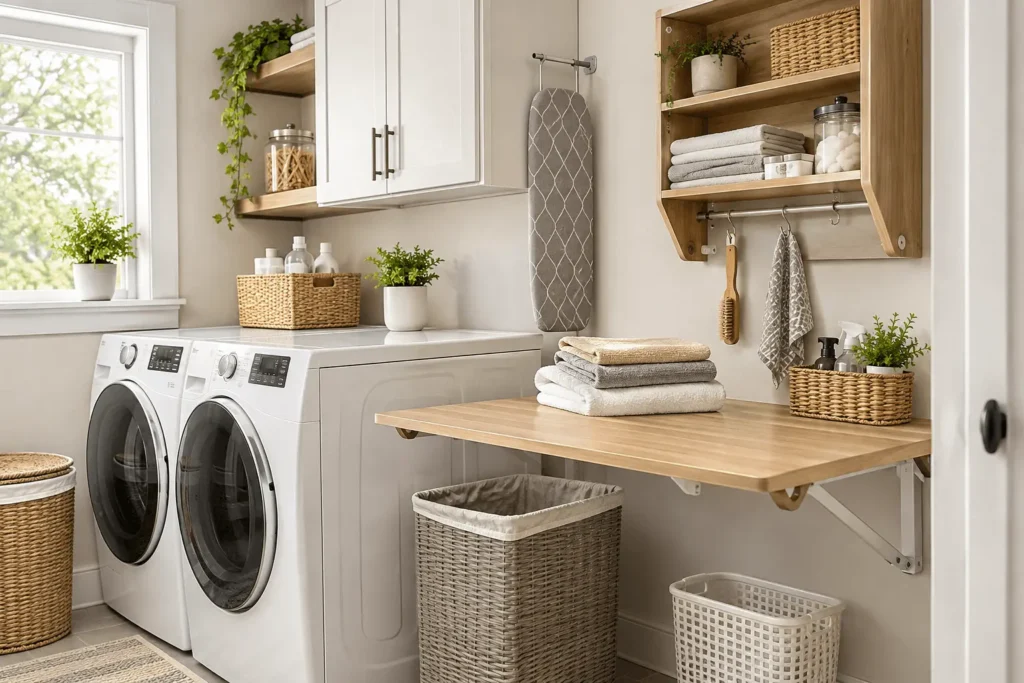
Install a Countertop Over Front-Load Machines
If your layout allows it, a countertop installed above front-loading appliances can provide a convenient folding surface.
Keep the surface relatively clear so it remains available for folding rather than becoming another storage area.
Use a Wall-Mounted Folding Table
A wall-mounted folding table can be folded away when not in use.
This is particularly useful in:
- Laundry closets
- Narrow utility rooms
- Apartments
- Small homes
When selecting one, make sure the folded and extended dimensions work with the surrounding doors and appliances.
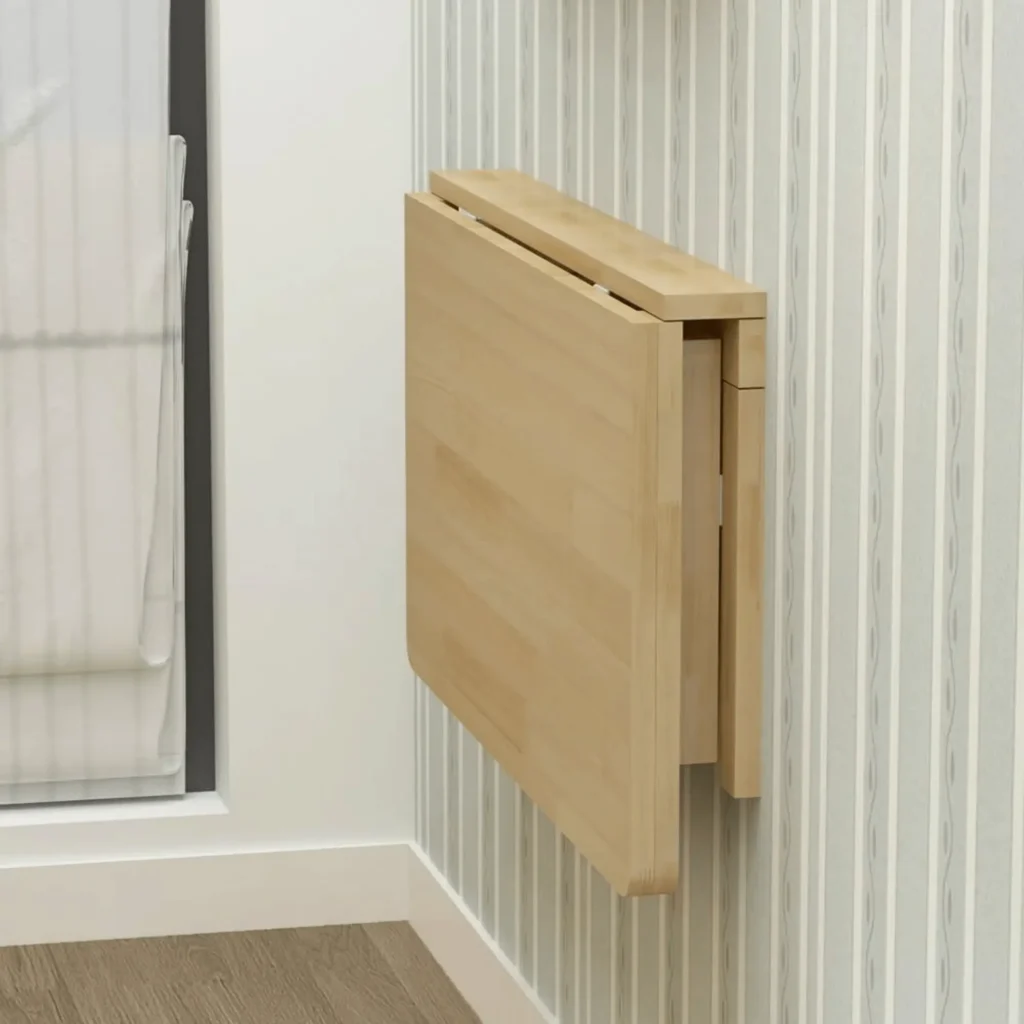
Solid Wood Wall-Mounted Folding Table
A solid wood wall-mounted folding table with a natural finish that provides a practical fold-down workspace without taking up valuable floor space. At 23.6″ D × 15.7″ W, it folds flat to just 3.1″ thick, making it ideal for small laundry rooms and multipurpose spaces.
Best For:
● Small laundry rooms
● Fold-down laundry work-spaces
● Compact homes and apartments
● Folding clothes or organizing laundry
● Multipurpose utility areas
Key Features:
● Solid wood construction
● Natural wood finish
● Wall-mounted, space-saving design
● Folds flat to just 3.1″ thick
● 23.6″ D × 15.7″ W
● Creates a convenient compact workspace
Add a Fold-Down Counter
A fold-down counter offers similar benefits while taking up minimal permanent space.
When folded up, it can preserve the walkway. When needed, it becomes a temporary workspace for folding clothes or sorting laundry.
Use a Removable Folding Board
For extremely small laundry areas, a removable folding board may be the simplest option.
Store it vertically against a wall or inside an appropriate cabinet when not in use. This approach creates a folding surface without requiring permanent furniture.
Key Point
In a small space, prioritize products that perform more than one job, such as a countertop that provides both folding space and storage.
Install a Wall-Mounted Drying Rack
Drying racks are useful for delicate garments, but traditional floor-standing racks can consume valuable space. A wall-mounted design solves this problem by shifting drying capacity from the floor to the wall.
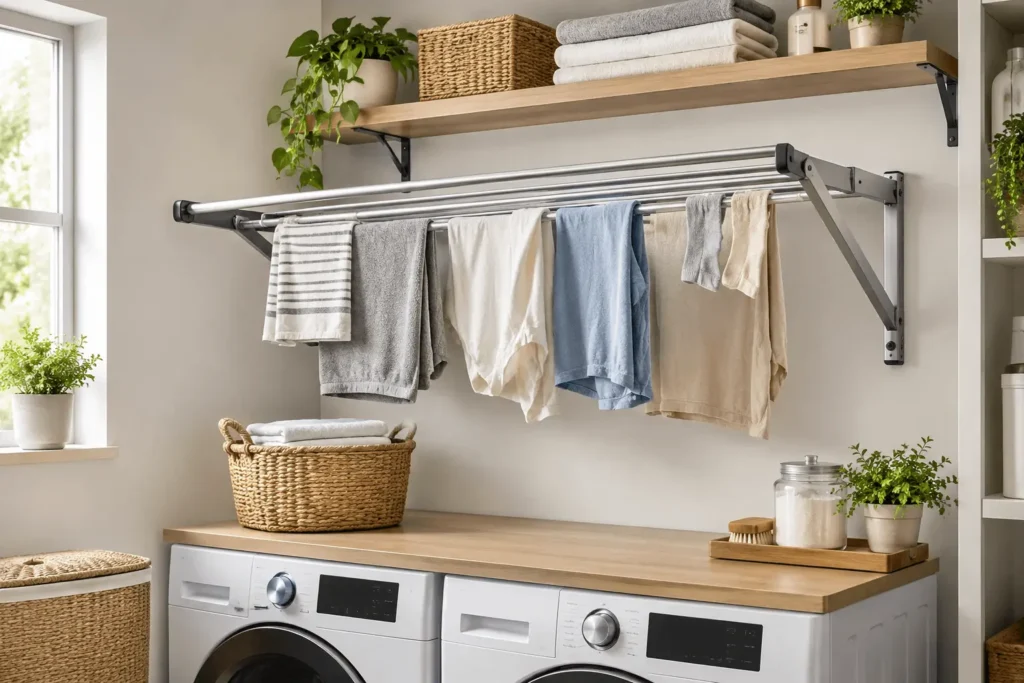
Foldable Drying Racks
Foldable drying racks can be opened when needed and folded against the wall afterward.
They’re particularly useful for households that only need occasional air-drying space.
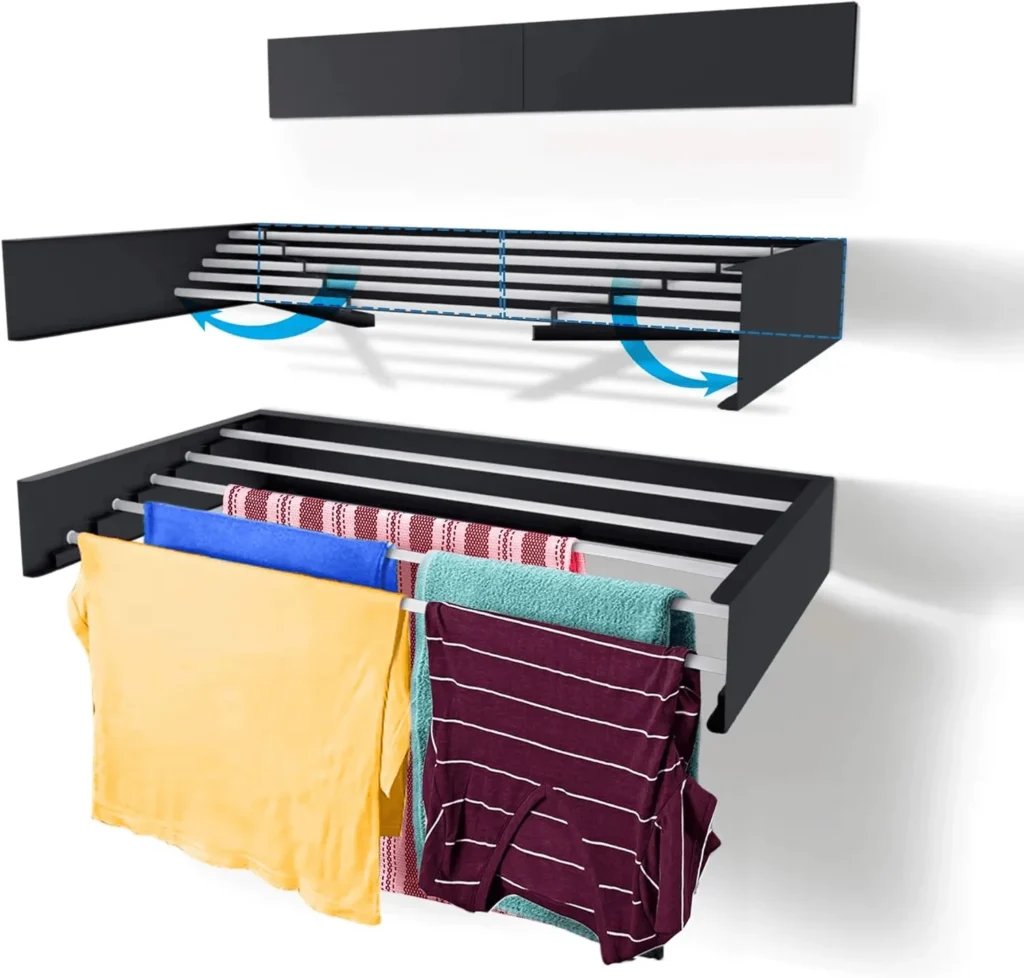
Foldable Wall-Mounted Clothes Drying Rack
Save floor space with this 80cm wall-mounted laundry drying rack, featuring five heavy-duty rods and a foldable design. Its sturdy metal construction provides a practical drying solution for small laundry rooms, bathrooms, balconies, and compact homes.
Best For:
● Small laundry rooms
● Apartments and compact homes
● Bathrooms and balconies
● Drying clothes and towels
● Maximizing vertical wall space
Key Features:
● Foldable wall-mounted design saves space.
● 5 heavy-duty rods for drying clothes and towels
● Strong 1.2mm metal construction.
● Supports up to 60 lbs.
● Rust- and scratch-resistant surface.
● Suitable for clothes, towels, and shoes.
● Easy wall installation with included hardware.
Accordion-Style Drying Racks
Accordion-style racks expand outward when needed and collapse relatively flat when not in use.
Their compact design makes them suitable for narrow laundry rooms.
Retractable Drying Lines
Retractable drying lines can provide temporary hanging space without permanently occupying a large area.
They can be especially useful when the room has suitable opposing walls and the installation is secure.
Where to Position a Drying Rack
Choose a location that:
- Doesn’t obstruct doors
- Doesn’t block appliance controls
- Allows garments to hang freely
- Doesn’t interfere with walking paths
- Has suitable wall construction for installation
The rack should improve functionality rather than create another obstacle.
Use the Back of the Door for Extra Storage
The back of a laundry room door is often overlooked. With the right lightweight organizer, it can provide valuable storage for smaller accessories.
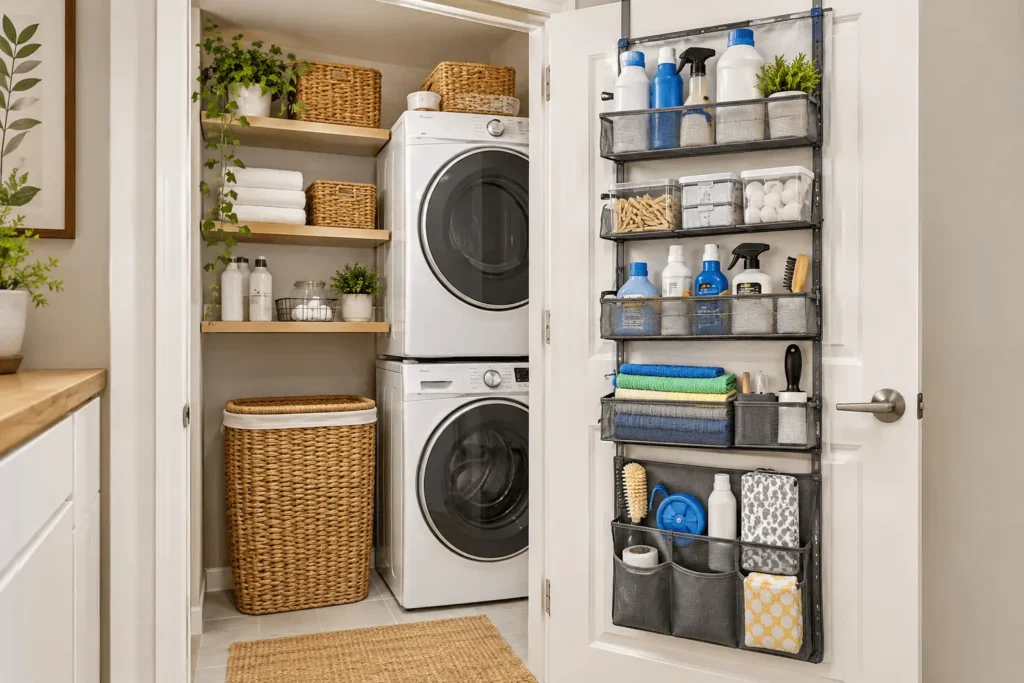
Over-the-Door Organizers
Over-the-door organizers can hold smaller laundry supplies without requiring wall drilling.
They’re useful for:
- Laundry bags
- Cleaning cloths
- Brushes
- Gloves
- Small accessories
Make sure the organizer doesn’t prevent the door from closing properly.
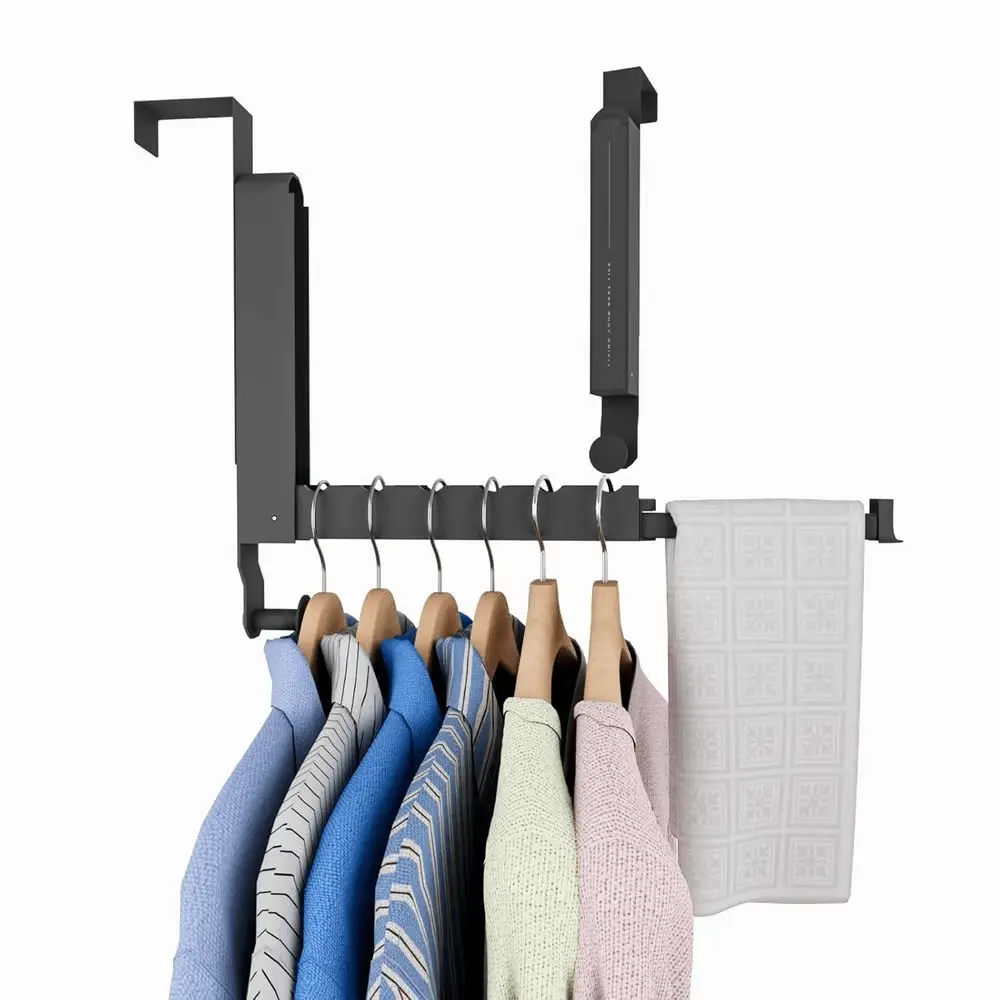
Portable Over-the-Door Drying Rack
A space-saving over-the-door drying rack with a retractable hanging rod and hooks, designed to add convenient drying and storage space without drilling. Its foldable, portable design makes it ideal for compact laundry rooms, apartments, and travel.
Best For:
● Small laundry rooms
● Apartments and dorms
● Towels and lightweight clothes
● Over-the-door storage
● Travel and temporary setups
Key Features:
● Foldable and portable design
● 5.9-inch retractable hanging rod
● Extra hanging space for clothes and towels
● Bottom hook for coats and bags
● Durable alloy construction
● Adjustable clamps fit doors up to 1.85 inches thick
● No drilling or permanent installation required
Door-Mounted Hooks
Hooks provide a simple solution for hanging lightweight items.
You can use them for:
- Reusable laundry bags
- Cleaning cloths
- Dusting tools
- Small brushes
- Garment bags
Slim Hanging Baskets
Hanging baskets can create additional vertical storage without consuming floor space.
Use smaller baskets for lightweight items rather than heavy containers that could put excessive stress on the door or mounting hardware.
Store Lightweight Items on the Door
The door is best suited to lightweight accessories rather than heavy detergent bottles or bulky equipment.
This keeps the door easy to operate and reduces stress on hinges and mounting hardware.
Pro Tip
Don’t overlook the back of the laundry room door. Over-door organizers and hooks can provide useful storage without taking up floor space.
Make Small Laundry Rooms Easier to Sort
Sorting laundry becomes harder when there isn’t enough room for multiple large baskets. The solution is to use compact sorting methods that match the household’s actual needs.
Use a Slim Hamper
A narrow hamper takes up less floor space than a wide basket.
Vertical hampers can be particularly useful in tight areas because they use height efficiently.
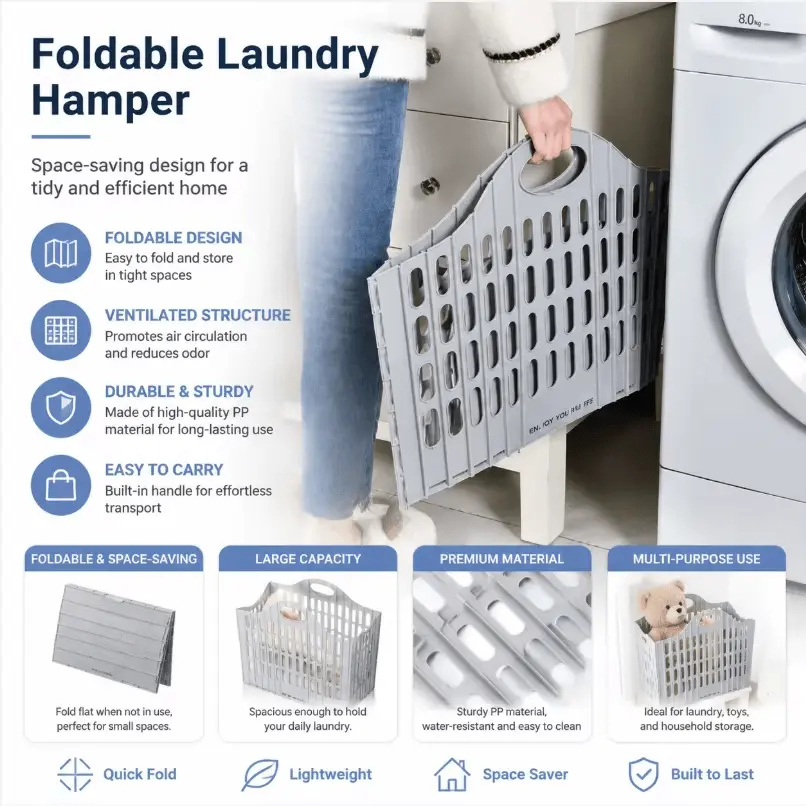
Foldable Plastic Laundry Hamper
Space-saving foldable plastic laundry hamper featuring a ventilated hollow design, durable PP construction, large capacity, and built-in carry handle. Ideal for organizing dirty clothes in small laundry rooms, bedrooms, bathrooms, dorms, and compact homes.
Best For:
● Small laundry rooms
● Apartments and dorms
● Bedrooms and bathrooms
● Compact closets
● Dirty clothes and household storage
Key Features:
● Foldable design saves storage space
● Ventilated structure promotes airflow
● Durable PP plastic construction
● Built-in handle for easy carrying
● Large capacity for dirty laundry
● Multipurpose household organizer
Choose a Divided Laundry Sorter
A divided sorter can separate different types of laundry without requiring several individual baskets.
Possible categories include:
- Lights
- Darks
- Towels
- Delicates
Choose only the categories that are genuinely useful for your household.
Assign Baskets by Laundry Type
For families with specific sorting routines, assigning individual baskets can simplify laundry day.
Use clear labels so everyone understands where clothes belong. This turns sorting into a simple routine rather than another task that must be completed later.
Smart Laundry Detergent Storage for Small Spaces
Laundry detergent containers can consume significant shelf space, especially when they are large or awkwardly shaped. Small laundry rooms benefit from a dedicated detergent storage strategy.
Use Narrow Detergent Containers
Choose appropriately sized containers that fit the available shelf or cabinet depth.
Avoid transferring products unless the container is suitable and you can maintain clear identification and follow applicable safety guidance.
Store Backup Supplies Higher Up
Backup detergent and other infrequently used supplies don’t need to occupy prime eye-level storage.
Use suitable upper cabinets or shelves for reserve supplies while keeping daily-use products within easy reach.
Use Pull-Out Organizers
Pull-out organizers can make narrow cabinets easier to access.
Instead of reaching behind several bottles, you can pull the organizer forward and see its contents more easily.
Avoid Oversized Containers
Large containers can quickly dominate a small shelf.
When practical, choose storage sizes that match your actual usage and available space rather than buying containers simply because they hold more.
Small Apartment Laundry Room Organization Ideas
Apartment laundry spaces often have additional challenges, including limited floor area, shared facilities, stacked appliances, or restrictions on permanent modifications.
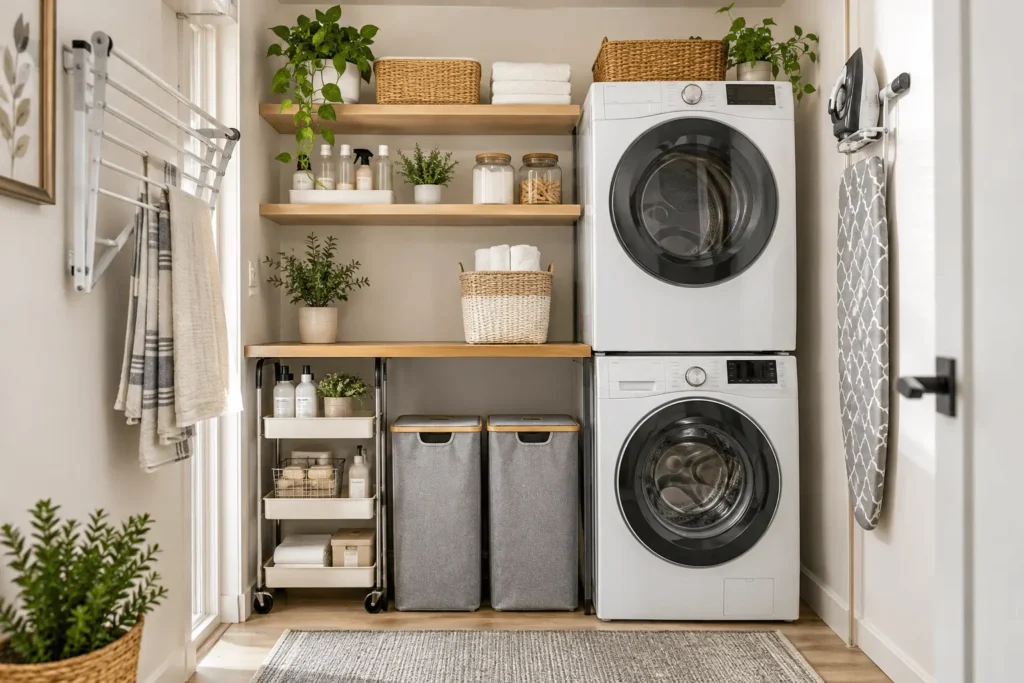
Use Renter-Friendly Storage
Renters can use removable and freestanding solutions such as:
- Removable hooks
- Freestanding carts
- Tension rods
- Over-the-door organizers
- Portable shelves
Always follow the property’s rules before installing anything.
Avoid Permanent Modifications When Renting
Before drilling into walls or installing built-in cabinetry, check your rental agreement.
Portable storage can provide many of the same organizational benefits without creating permanent changes.
Make a Closet Laundry Area More Functional
For a laundry closet, focus on vertical organization and keeping the floor clear.
Use:
- Slim baskets
- Wall-mounted accessories where permitted
- Door organizers
- Stackable containers
- Foldable drying equipment
The goal is to preserve access to the appliances while making use of otherwise unused space.
Organize a Shared Laundry Area
If laundry facilities are shared, use portable containers and clearly separated personal supplies.
A small laundry bag or portable caddy can keep your detergent and accessories together so they can be moved easily when needed.
Pro Tip
A few inexpensive upgrades—such as hooks, baskets, shelf risers, and a slim cart—can sometimes improve a small laundry room more than a costly renovation.
Small Laundry Room Ideas for Stacked Washers and Dryers
Stacked appliances create useful vertical capacity but can make surrounding storage more challenging.
Use the Wall Beside the Machines
A narrow wall beside stacked appliances can accommodate shelves, hooks, or a slim storage tower.
This area can become a dedicated zone for detergent and laundry accessories.
Add Shelves Above the Appliances
If the installation allows it, shelves above stacked appliances can provide additional storage.
Use upper shelves for less frequently accessed items and keep everyday products lower.
Install a Slim Rolling Cart
A slim cart can take advantage of narrow spaces beside stacked appliances.
Its vertical tiers can separate different categories without requiring a full cabinet.
Keep the Floor Clear
Avoid filling the area around stacked appliances with unnecessary furniture.
A clear floor makes the laundry room easier to clean and keeps appliance access straightforward.
Small Laundry Room Organization Ideas Without Cabinets
You can create an organized laundry room even without built-in cabinetry.
Use Floating Shelves
Floating shelves provide accessible open storage without requiring a traditional cabinet.
Use baskets to control visual clutter.
Add Freestanding Storage
A narrow freestanding shelf or storage tower can provide cabinet-like capacity without permanent installation.
Choose furniture that fits comfortably within the available dimensions.
Use Baskets for Visual Organization
Open shelves can look messy when individual products are scattered everywhere.
Grouping similar items inside matching baskets creates visual order.
Install Wall Hooks and Rails
Hooks and rails are useful for lightweight accessories and can keep items off the floor.
Create Open Storage Zones
Instead of randomly placing items on shelves, assign each shelf a specific function.
For example:
Shelf 1: Daily laundry supplies
Shelf 2: Towels and baskets
Shelf 3: Backup supplies
This makes open storage easier to maintain.
Hidden Storage Ideas for Small Laundry Rooms
Hidden storage helps small laundry rooms appear cleaner because supplies aren’t constantly visible.
Use Matching Storage Baskets
Matching baskets create a cohesive appearance while hiding miscellaneous items.
They work especially well on open shelves.

45L Collapsible Storage Bin
Keep a small laundry room organized with this 45L collapsible storage bin. Its roomy capacity, durable PP construction, ergonomic handles, and fold-flat design make it practical for storing clothes, laundry essentials, and household items while saving valuable space.
Best For:
● Small laundry rooms
● Clothes and laundry storage
● Household organization
● Garage and closet storage
● Space-saving storage
Key Features:
● 45L large storage capacity
● Foldable, space-saving design
● Durable PP plastic construction
● Ergonomic carry handles
● Stackable storage solution
● Suitable for clothes and household items
Hide Supplies Behind Cabinet Doors
If your room has cabinets, reserve them for products that don’t need to remain visible.
Keep everyday supplies accessible while hiding less attractive packaging.
Use Lidded Containers
Lidded containers can reduce visual clutter and protect contents from dust.
Use clear labels so you don’t have to open every container to identify what’s inside.
Store Infrequently Used Items Out of Sight
Seasonal or occasional items should not compete with everyday necessities for prime storage space.
Move them to higher shelves, suitable cabinets, or another appropriate storage area.
25+ Space-Saving Laundry Room Organization Ideas
When space is limited, small improvements can add up to a significant increase in functionality. The following ideas focus specifically on making better use of walls, doors, narrow gaps, and multifunctional storage.
1. Install Floating Shelves
Use unused wall space for detergent, baskets, towels, and small containers.
2. Add a Slim Rolling Cart
A narrow cart can fit into unused gaps and provide several levels of accessible storage.
3. Install a Fold-Down Table
Create a temporary folding surface without permanently occupying valuable floor space.
4. Use Stackable Bins
Stackable containers help maximize vertical cabinet and shelf capacity.
5. Add Over-the-Door Storage
Use the back of the door for lightweight accessories and small laundry supplies.
6. Install a Wall-Mounted Drying Rack
Move drying activities off the floor with a foldable wall-mounted rack.
7. Use a Narrow Hamper
A slim hamper provides dirty-clothes storage while preserving walkway space.
8. Add Magnetic Storage
Where appropriate, magnetic organizers can use compatible metal appliance surfaces for lightweight accessories.
9. Use Wall Hooks
Hooks are inexpensive and useful for laundry bags, brushes, and cleaning cloths.
10. Install a Pegboard
A pegboard creates customizable vertical storage for frequently used lightweight tools and accessories.
11. Choose Matching Baskets
Matching baskets reduce visual clutter and give open shelving a more cohesive appearance.
12. Use Shelf Risers
Shelf risers create additional levels inside cabinets and make better use of vertical cabinet space.
13. Install a Slim Cabinet
A narrow cabinet can provide concealed storage without requiring the footprint of a large storage unit.
14. Store Backup Products on High Shelves
Reserve convenient storage for everyday items and place suitable backup supplies higher up.
15. Use Clear Containers
Clear containers make it easier to identify contents quickly.
16. Create a Dedicated Stain-Treatment Zone
Keep stain-treatment products together so they can be located quickly when needed.
17. Add a Wall-Mounted Ironing Board
A wall-mounted or fold-away ironing solution can eliminate the need to store a full-size ironing board on the floor.
18. Use Collapsible Baskets
Collapsible baskets can be folded down when empty, reducing storage requirements.
19. Add a Tension Rod
Where appropriate, a tension rod can provide temporary hanging space without taking up floor area.
20. Use the Sides of Cabinets
Cabinet sides can sometimes accommodate hooks or small organizers for lightweight items.
21. Create a Lost-Sock Basket
A small dedicated container prevents unmatched socks from accumulating on countertops.
22. Use a Narrow Shelf Above the Door
If the room’s height and construction permit it, a shallow upper shelf can hold rarely used items.
23. Install Cabinet Door Organizers
The inside of cabinet doors can provide useful storage for small accessories.
24. Use a Rolling Laundry Sorter
A rolling sorter combines mobility with laundry categorization.
25. Keep One Basket for Clean Laundry
A designated clean-laundry basket prevents freshly washed clothing from piling up on countertops or appliances.
26. Label Every Storage Zone
Labels make it easier for household members to return supplies to their correct locations.
How to Make a Small Laundry Room Look Bigger
Good organization can influence how spacious a room feels. The objective isn’t to make the room physically larger but to reduce visual clutter and preserve clear sightlines.
Use Light Colors
Light walls, cabinets, and textiles can create an airy appearance. Neutral colors can also make storage containers easier to coordinate.
Keep Countertops Clear
A crowded countertop can make even a reasonably sized laundry room feel cramped.
Keep only essential items on the work surface and move backup supplies into designated storage.
Choose Matching Containers
Consistent baskets and containers reduce visual noise.
Instead of displaying dozens of differently shaped packages, group supplies into coordinated storage where appropriate.
Use Mirrors Carefully
A strategically positioned mirror can reflect light and create a greater sense of depth.
However, avoid placing mirrors where they create awkward reflections or interfere with the practical function of the laundry area.
Maintain Clear Floor Space
One of the easiest ways to make a small room feel larger is to keep as much floor area visible as possible.
Prioritize wall-mounted and vertical storage whenever practical.
Budget-Friendly Small Laundry Room Organization Ideas
You don’t need a complete renovation to improve a small laundry room. Many effective changes involve reorganizing what you already own and adding a few affordable storage solutions.
Use Affordable Storage Bins
Basic plastic or fabric bins can organize supplies without requiring expensive cabinetry.
Prioritize durability, appropriate sizing, and easy cleaning.
Repurpose Existing Containers
Before purchasing new organizers, look around your home for suitable containers you already own.
Repurposing can reduce costs while keeping useful items out of storage elsewhere.
Install Simple Hooks
Hooks are inexpensive and can provide immediate hanging storage for lightweight accessories.
DIY Floating Shelves
If you have the necessary tools and skills, simple shelves can provide affordable vertical storage.
Always use appropriate mounting hardware and ensure the installation is suitable for the wall and expected load.
Prioritize High-Impact Purchases
If your budget is limited, don’t buy everything at once.
Start with the items that solve your biggest problems.
For example:
- Slim storage cart
- Vertical shelving
- Compact hamper
- Drying rack
- Folding solution
This approach allows you to improve the room gradually.
Best Storage Products for Small Laundry Rooms
The best products for a compact laundry room are those that provide useful storage without consuming unnecessary floor space. Prioritize products that are narrow, vertical, foldable, stackable, portable, or multifunctional.
| Product Type | Best For | Space Required | Price Level |
|---|---|---|---|
| Slim rolling cart | Narrow gaps | Very low | $ |
| Floating shelves | Vertical storage | Low | $ |
| Wall drying rack | Air drying | Very low | $$ |
| Storage bins | Shelves/cabinets | Low | $ |
| Slim hamper | Dirty laundry | Medium | $$ |
| Fold-down table | Folding clothes | Very low | $$ |
| Storage cabinet | Concealed storage | Medium | $$$ |
Budget Guide
$ = budget-friendly, $$ = mid-range, and $$$ = premium or higher-cost options.
Actual prices may vary depending on the product, brand, size, and materials.
When choosing products, measure your available space first. A highly rated organizer isn’t useful if it blocks an appliance door or makes the room difficult to navigate.
Small Laundry Room Organization by Layout
Not every small laundry room has the same shape. The best organization strategy depends heavily on the layout, appliance position, door location, and available wall space.
Single-Wall Laundry Room
A single-wall laundry setup typically places appliances along one wall.
Prioritize:
- Vertical shelving
- Wall-mounted drying solutions
- Slim storage
- Appliance-top workspace where appropriate
Keep the floor area open to preserve movement.
Narrow Laundry Room
A narrow room requires careful attention to depth.
Choose shallow shelving, slim carts, wall-mounted organizers, and compact hampers rather than deep furniture that reduces the walkway.
Laundry Closet
Laundry closets often provide very little additional storage.
Make use of:
- Door organizers
- Upper shelving
- Slim baskets
- Foldable equipment
- Stackable storage
Keep the area immediately around the appliance doors clear.
Galley-Style Laundry Room
A galley layout has storage or appliances arranged along opposing sides.
Avoid filling both sides with deep furniture. Maintain a comfortable central walkway and place frequently used supplies where they are easiest to reach.
Stacked Washer and Dryer Layout
Stacked machines create more usable floor area but often leave awkward vertical zones.
Use surrounding walls for shelving and keep the floor clear for maintenance access and comfortable movement.
Common Small Laundry Room Organization Mistakes
Even well-intentioned organization projects can make a small room less functional. Avoiding common mistakes helps you get more value from every storage decision.
Buying Oversized Storage Furniture
Large cabinets may look attractive but can overwhelm a compact room.
Always measure the available area before purchasing furniture.
Filling Every Available Wall
Not every empty wall needs shelves.
Overloading the walls can make the room visually crowded and may reduce access to appliances or controls.
Ignoring Appliance Access
When planning a small laundry room, keep washer and dryer access clear for loading, unloading, maintenance, and efficient use of the available space. For energy-efficient laundry appliances, explore the official ENERGY STAR guide to clothes washers.
Leave appropriate clearance according to your appliance manufacturer’s instructions.
Using Too Many Open Containers
Open storage is convenient, but too many visible containers can create visual clutter.
Use a combination of open shelves and closed or lidded storage where appropriate.
Storing Everything at Eye Level
Eye-level space is valuable. Reserve it for products you use frequently.
Less frequently used items can go into higher storage.
Forgetting to Measure Before Buying
This is one of the most expensive mistakes in a small laundry room.
Measure:
- Width
- Depth
- Height
- Door swing
- Appliance clearance
- Shelf clearance
- Walking space
Then compare those measurements with the product dimensions before purchasing.
Small Laundry Room Organization Checklist
Use this checklist to turn your small-space organization project into a manageable process.
- Measure the entire laundry area.
- Measure gaps beside and above appliances.
- Declutter unnecessary supplies.
- Remove broken or unused organizers.
- Identify vertical storage opportunities.
- Choose narrow or stackable organizers.
- Create a dedicated detergent zone.
- Add a compact hamper.
- Install suitable wall storage.
- Add a wall-mounted drying rack if needed.
- Create a compact folding area.
- Use the back of the door where appropriate.
- Label storage containers.
- Keep heavy items on suitable lower storage.
- Store backup supplies separately.
- Keep appliance access clear.
- Maintain a clear walkway.
- Review the organization system regularly.
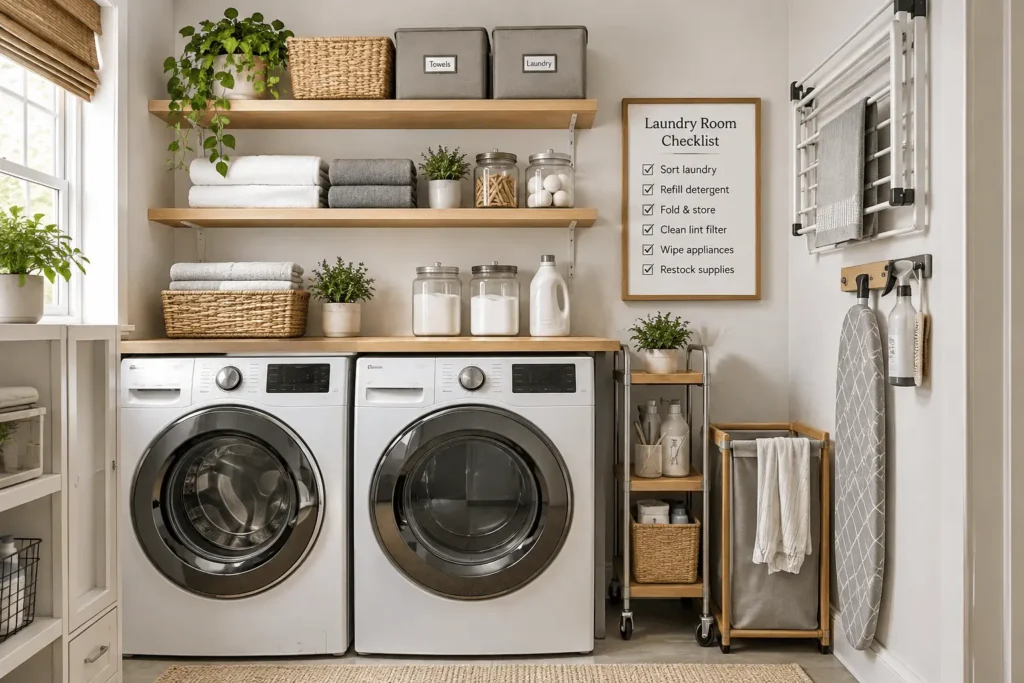
How to Organize a Small Laundry Room Step by Step
A step-by-step process prevents the project from becoming overwhelming. Instead of purchasing products immediately, build the organization system around your actual space and routine.
Step 1: Measure the Room
Measure the available walls, gaps, ceiling height, appliance dimensions, door clearance, and usable floor area.
Don’t rely on estimates when purchasing storage for a compact room. Even a small difference in dimensions can determine whether a product fits.
Step 2: Declutter
Remove unnecessary items before organizing.
The less you need to store, the easier it becomes to create an efficient system.
Step 3: Create Zones
Divide the room into practical zones.
For example:
Dirty laundry zone: Hampers and sorting
Washing zone: Detergent and stain-treatment supplies
Drying zone: Drying rack and garment accessories
Folding zone: Countertop or fold-down table
Backup zone: Infrequently used supplies
Step 4: Add Vertical Storage
Start with your highest-value storage opportunities.
Walls, upper shelves, and suitable spaces above appliances can often provide storage without reducing floor area.
Step 5: Organize Frequently Used Items
Keep the products you reach for most often in accessible locations.
This improves the laundry workflow and prevents you from constantly moving other items to reach everyday supplies.
Step 6: Hide Infrequently Used Supplies
Move seasonal, backup, or occasional items into appropriate upper or concealed storage.
Label these areas clearly so they remain easy to manage.
Step 7: Maintain the System
A good organization system should be easy to maintain.
Spend a few minutes each week returning items to their designated locations, removing unnecessary clutter, and checking that storage areas remain functional.
Key Point
A small laundry room stays organized when every item has a designated home and household members consistently return items after use.
Final Thoughts
A small laundry room can still be highly functional, attractive, and easy to maintain when every part of the space is planned intentionally. Instead of trying to squeeze more furniture into a limited area, focus on vertical storage, compact organizers, multifunctional furniture, wall-mounted accessories, and clearly defined zones.
The most effective approach is simple: measure first, declutter before shopping, use overlooked spaces, keep everyday essentials accessible, and avoid unnecessary storage products. With these principles, even a tiny laundry closet or apartment laundry area can become a practical and organized part of the home.
If you want a broader collection of organization strategies for laundry rooms of every size and layout, explore our main guide: 75+ Laundry Room Organization Ideas to Maximize Every Space.